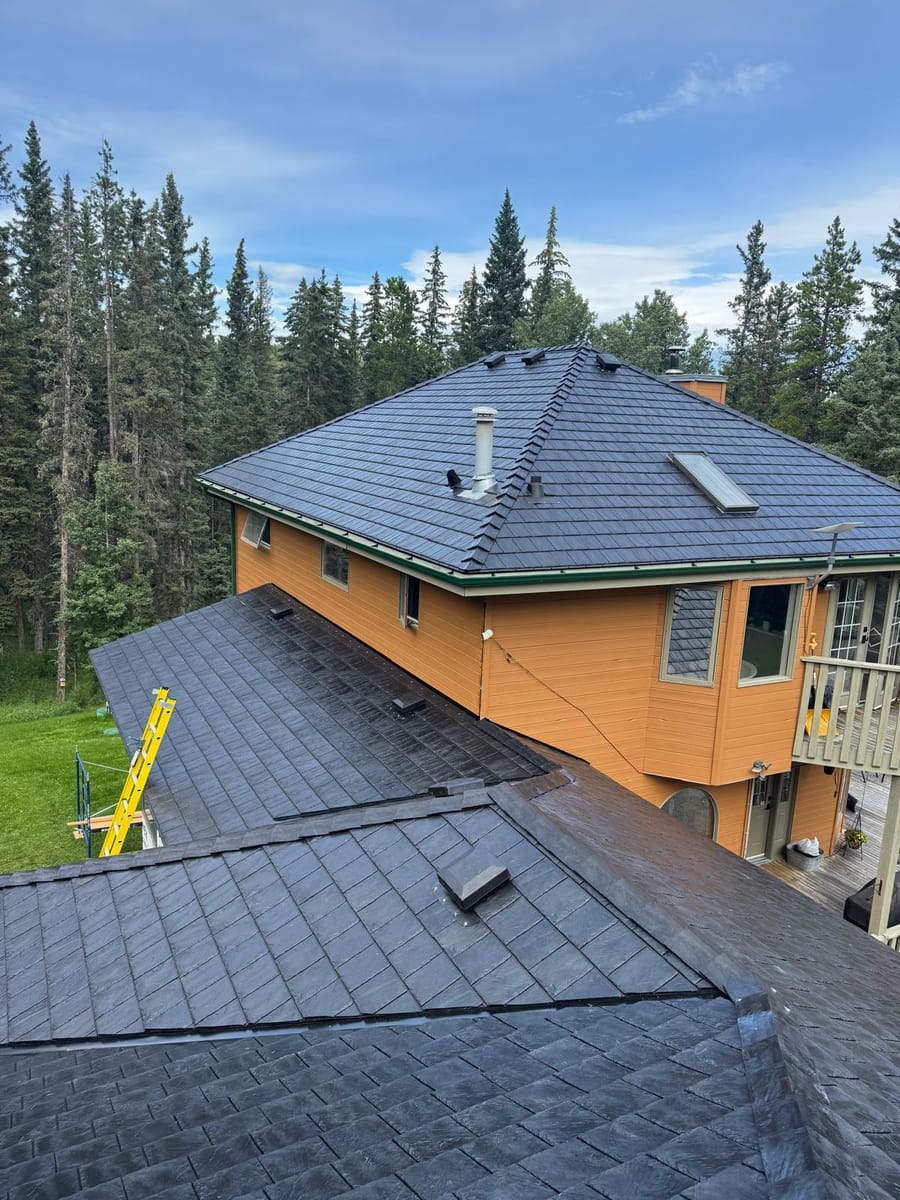
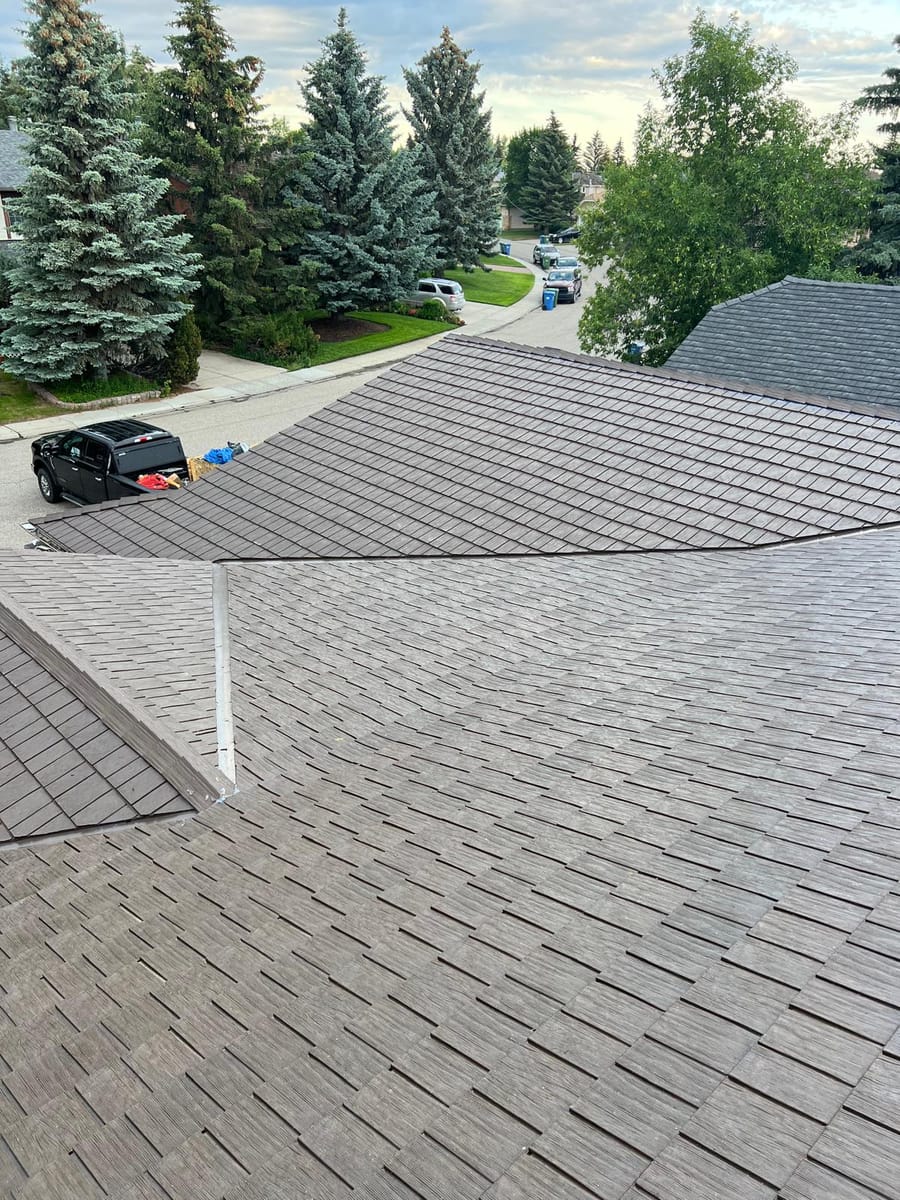
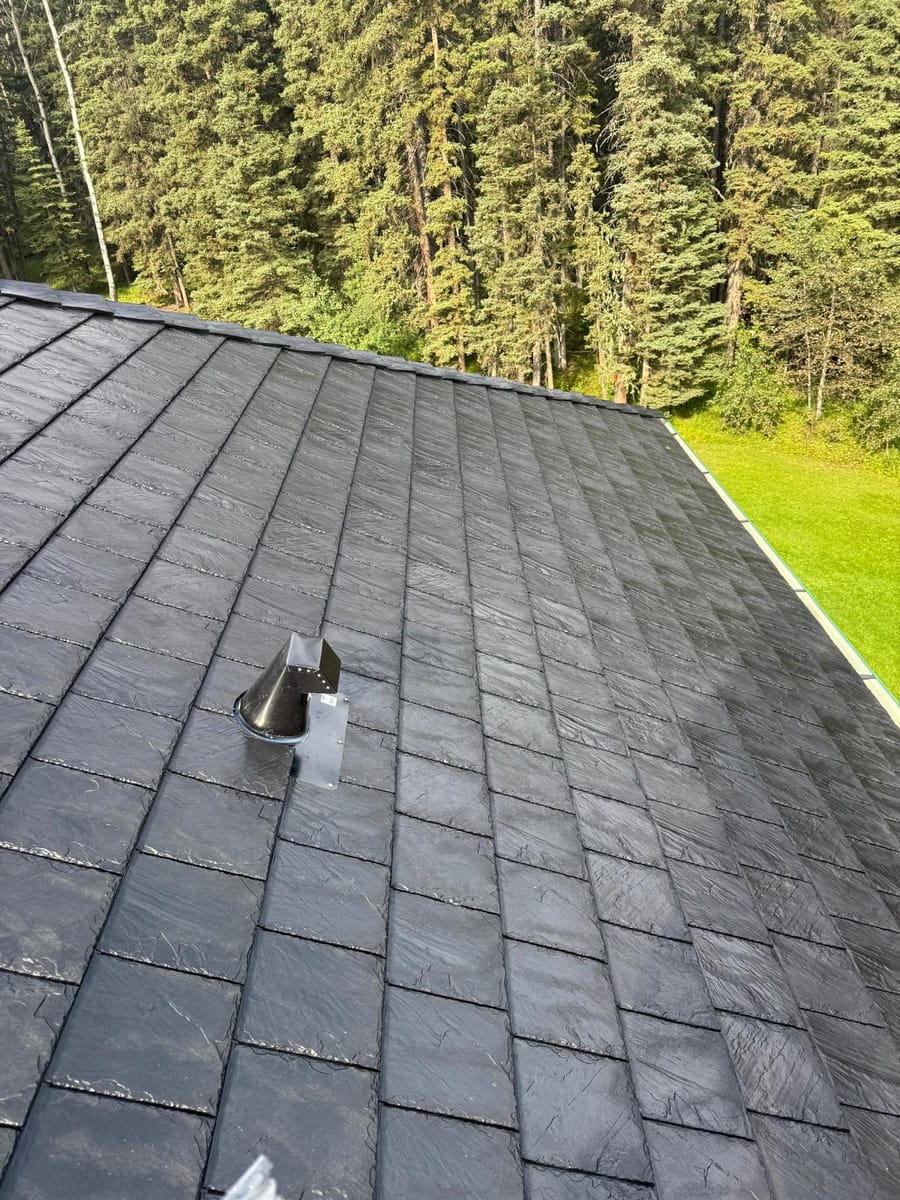
What are Euroshield shingles made of, and where are they made?
Euroshield panels are rubber roofing panels manufactured in Calgary, Alberta, by G.E.M. Inc., which makes and distributes the system. Euroshield lists two code evaluation reports, QAI CERus-1013 and Florida FL46844, and cites the ICC International Building Code and International Residential Code evaluation.
Euroshield states that the panels are manufactured from 70% recycled tires, using crumb rubber derived from those tires, that about 300 tires go into one roof, and that the panels are fully recyclable at the end of their life.
This guide covers four profiles, plus two Hail Proof variants. Ranchland Shake and Rundle Slate share one set of installation instructions; Vermont Slate and Beaumont Shake share another that also covers Vermont Slate HP and Beaumont Shake HP. Euroshield lists 4 colours: Black, Grey, Brown and Driftwood.
The wood originals these profiles imitate differ in one way: a shingle is sawn on all sides, while a shake is split so one face is not sawn. Both are usually western red cedar, which must be chemically treated to last and to achieve a fire resistance rating.
Confirm panel weight and the weight of a finished roof with Euroshield. The installation rules do require a deck at the building code thickness for the region, supports no more than 600 mm (24 in) apart, and a smooth, flat deck in good condition.
Does Euroshield resist hail, and what exactly is promised?
Euroshield's warranty covers hail as a named risk, but the promise has limits a Calgary owner should read closely.
For products installed after August 1, 2024, the 50-year pro-rated warranty gives every profile a Basic Hail Warranty: for 50 years, the field panel is warranted against cracking, splitting or perforation from hail of 2 inches diameter or less, as verified by weather data for the area.
Hail over 2 inches is not covered, and neither are surface scratches or minor scuffing. The Hail Proof Warranty applies only to Vermont Slate HP and Beaumont Shake HP: for 20 years it covers hail greater than 2 inches, after which those panels revert to the 2-inch coverage for the remaining 30 years.
Three conditions apply to any hail claim. You must report suspected damage within 30 days of the weather event and supply third-party weather data. An accredited or certified roof inspector must verify the damage, and G.E.M. Inc. alone decides whether hail caused it. And for any insurable event you must first exhaust your own insurance; the warranty reimburses only costs the insurer did not, excluding the deductible.
In Calgary, where hail falls from May to September and the August 2024 storm was among the costliest insured events in Canadian history, a hail claim therefore starts with your insurer, not with Euroshield.
For extreme hail areas Euroshield also describes a tight valley, with a gap of only 1/8 inch each side of the valley centre and sealant under each panel, in place of the standard open valley with a 2-inch gap.
How is Euroshield installed, and on what slope?
Euroshield is installed as interlocking panels on a slope of 4/12 or greater, over a solid plywood or OSB deck, synthetic underlayment and code eave protection, with every nail hidden.
All profiles are designed for 4/12 and above. For Vermont Slate and Beaumont Shake, work below 4/12 requires contacting Euroshield first, and installation is not recommended below 3/12. Mansard and vertical applications also require contact before work starts.
The deck must be plywood, OSB or equivalent at the thickness the regional code requires, fastened and clipped unless Euroshield approves otherwise, on supports no more than 600 mm (24 in) apart.
Eave protection must meet the National Building Code, overhang the fascia 25 mm (1 in), with end laps of 150 mm (6 in), sealed.
The underlayment must be synthetic and comply with ASTM D226 Type I or II, ASTM D4869 Type I or II, or ASTM D6757. Metal flashing must be at least 26 gauge.
Ventilation is set above code: not less than 1 sq ft of unobstructed vent area per 150 sq ft of insulated ceiling, about 50 percent at the lower roof for intake and 50 percent near the ridge for exhaust, twice the National Building Code's 1 in 300.
Cathedral ceilings need at least 2 inches between sheathing and insulation, and on slopes steeper than 8/12 a larger ridge cap may be needed over a ridge vent.
The warranty excludes distortion, warping or curling from heat in an under-vented attic, so the recommendation has teeth. A separate guide covers attic ventilation and ice dam prevention in Calgary.
Fastening is prescriptive: 11-gauge or heavier corrosion-resistant (electro-galvanized) roofing nails with a head of at least 3/8 in (9.5 mm), at least 1 3/4 in (44.5 mm) long, penetrating 3/4 in (19 mm) below the deck, driven straight and flush only where the panel is marked "O".
Euroshield permits no exposed standard roofing nails; where a fastener must show, it calls for sealant and a 2-inch 18-gauge brad nail. The recommended minimum installation temperature is -20 C (14 F).
Euroshield profiles compared
| Profile | Flat reveal (where a solar mount sits) | Slope rule | Hail coverage |
|---|
| Ranchland Shake | 10 in | 4/12 or greater; contact Euroshield for mansard or vertical | 2 in or less, 50 years |
| Rundle Slate | 10 in | 4/12 or greater; contact Euroshield for mansard or vertical | 2 in or less, 50 years |
| Vermont Slate | 9 in | 4/12 or greater; contact Euroshield below 4/12; not recommended below 3/12 | 2 in or less, 50 years |
| Beaumont Shake | 9 in | Same as Vermont Slate | 2 in or less, 50 years |
| Vermont Slate HP | 9 in | Same as Vermont Slate | Over 2 in for 20 years, then 2 in or less to year 50 |
| Beaumont Shake HP | 9 in | Same as Vermont Slate | Over 2 in for 20 years, then 2 in or less to year 50 |
"Rubber" causes confusion with flat roofs. Low-slope roofing is grouped by membrane type, and EPDM rubber membranes are one of those types. Euroshield is a moulded panel for 4/12 and steeper that locks course to course. A "rubber roof" quote for a flat garage means a membrane, not Euroshield.
What does the Euroshield warranty cover, and what must the owner do?
The warranty covers manufacturing defects that materially affect performance for 50 years, hail as described above, and labour for the first 5 years, provided the owner registers it and follows the claim rules. The purchase certificate must be signed and returned to G.E.M. Inc. within 90 days of installation, with the product and the contractor paid in full. It may be transferred once, to a buyer within 10 years of installation, if notice and the transfer fee reach G.E.M. Inc. within 90 days of the sale; the transferee takes only the balance.
Coverage steps down. For the first 120 months G.E.M. Inc. may repair, replace or refund. After 120 months its sole responsibility is a pro-rated refund of the original panel price, the months remaining in the 50-year period divided by 600, excluding installation.
Labour for removal, repair, replacement and disposal is borne by the manufacturer only if the defect appears within 5 years, and is capped at the lesser of the original installation cost, local rates, or a per-square limit stated in the warranty.
Vertex Roofing & Exteriors Ltd. installs Euroshield rubber roofing across Calgary, Airdrie, Okotoks and the foothills acreage communities. Every installation carries Euroshield's warranty plus our own 10-year workmanship warranty.
The exclusions matter in Calgary.
Not covered: damage from paint, coatings, solvents or cleaners; uniform colour change from weathering, including the settling of the new mould sheen; distortion from heat in an under-vented attic; failure of the deck beneath; winds over 145 kph, and any damage after exposure to winds over 145 kph; and any loss from ice damming, ice build-up, or ice and snow sliding off the roof.
Chinook gusts and freeze-thaw cycles are the owner's and installer's problem, not the manufacturer's; Euroshield recommends snow guards where accumulation risk is high.
One clause overrides the rest: the panels must not be installed over an existing roof covering, whether asphalt, cedar, pine or other. The old roof comes off so trusses, sheathing, fascia, masonry, plumbing and mechanical components can be inspected and repaired.
Installing over an existing roof voids the warranty, as do later repairs with non-Euroshield components. Claims go to G.E.M. Inc. by registered mail within 45 days of discovering a problem; telling your contractor does not count.
What the installer must get right: layout, valleys, penetrations and caps
The visible quality of a Euroshield roof depends on layout, and it must not be installed straight up the roof like asphalt shingles.
Panels carry row-number markings, and each course is offset by the marked amount so keyways (the gaps between simulated tiles) never align with the course below; no panel joint may fall within 5 inches of a joint in the course above or below.
The eave starter strip is set with a 3/4-inch overhang, begins with a half panel, and takes 8 nails of 1 3/4 in.
Valleys are layered: one layer of ice and water membrane, a 24-inch metal valley over it, then an 18-inch strip of membrane each side starting 3 inches from the centreline, with panels starting 2 inches from the centre.
At pipes and vents the installer seals every locking channel and lays a 6-inch strip of membrane over the upper edge and sides of the flashing before the panels go on.
Where step flashing at walls and chimneys would prevent a panel lying flat, the installer trims the extended butt-edge lock and seals it underneath with Solar Seal #900 or equivalent. The end of every locking channel at each course is filled with sealant.
Hip and ridge caps cover about 4.5 inches each side and take 4 galvanized deck screws, 2 per side (3-inch screws over a ridge vent); the last cap is face-fastened through sealant with a 2-inch brad nail.
A cap must be warm enough before it is bent to the ridge pitch, a real constraint at -20 C.
For solar mounts, the plate sits on the flat portion of a course (the 10-inch reveal on Ranchland Shake and Rundle Slate, 9 inches on Vermont Slate and Beaumont Shake) with a sealant gasket under the plate and on the lag screws.
Rubber shingles or Class 4 asphalt for a Calgary roof?
The choice comes down to what each warranty promises after hail, because a UL 2218 Class 4 rating is a laboratory impact test while the Euroshield warranty is a written promise of coverage for hail to 2 inches for 50 years.
The two are different kinds of promise, but they can be compared on paper: read the asphalt manufacturer's exclusions for hail and storms, then set them beside the Euroshield hail clauses above, including the requirement to claim on your own insurance first.
The other differences are installation rules. Euroshield requires a full tear-off, synthetic underlayment to ASTM D226, D4869 or D6757, ventilation at 1 in 150, hidden 11-gauge nails, 26-gauge flashing and a slope of 4/12 or more, and asks for an annual inspection.
The price drivers are roof area, pitch, the number of valleys, hips and penetrations, HP versus standard profile, and the tear-off. None of the Calgary quotes reviewed priced a Euroshield roof, so ask for Euroshield and Class 4 asphalt priced on the same roof.
On the asphalt side, Class 4 Malarkey Vista re-roofs ran $485 to $600 per square all-in, before GST, in 2025 Calgary quotes.
What this means for a Calgary roof
Euroshield is made in the city it is sold in, and it can be installed down to -20 C, which suits a Calgary schedule.
Its warranty names hail, the risk that matters here from May to September, but only to 2 inches on standard profiles, with insurance first and weather data in hand, and it excludes ice damming and Chinook gusts over 145 kph outright.
The roof performs as warranted only if the deck is solid, the attic is vented at 1 in 150 and every nail is hidden. Vertex Roofing & Exteriors Ltd. installs to Euroshield's instructions and can inspect your deck and quote the work for a Euroshield rubber roof; call (587) 434-4611.
Questions people ask
What are Euroshield shingles made of?
Euroshield is a rubber roofing system manufactured in Calgary by G.E.M. Inc. Confirm the recycled content with the manufacturer's current product information.
Does Euroshield resist hail?
The warranty covers cracking, splitting or perforation from hail of 2 inches or less for 50 years on every profile, and hail over 2 inches for 20 years on the HP profiles. Scratches and scuffing are excluded, and you must claim insurable hail damage on your own insurance first.
How is Euroshield installed and on what slope?
On slopes of 4/12 or greater, over a plywood or OSB deck on supports no more than 600 mm (24 in) apart, with synthetic underlayment, code eave protection and hidden 11-gauge nails. Below 4/12 the installer must contact Euroshield first; below 3/12 it is not recommended.
What does the Euroshield warranty cover?
Manufacturing defects for 50 years on a pro-rated basis, hail as above, and labour only for defects within the first 5 years. Registration within 90 days, a full tear-off and claims by registered mail within 45 days are conditions; winds over 145 kph and ice damming are excluded.
How heavy is a rubber shingle roof?
Confirm the weight per square with Euroshield or the installer. The deck must meet building code thickness on supports no more than 600 mm (24 in) apart, so ask your installer to confirm the structure.
Rubber shingles or Class 4 asphalt for a Calgary roof?
Compare the warranty language, not the label: Euroshield writes hail to 2 inches into a 50-year warranty, while a Class 4 rating is a UL 2218 impact test and the asphalt warranty may exclude hail. Read both warranties' exclusions before you decide.